

Secrets of Strixhaven Prerelease Guide: New Mechanics, Archetypes, and Top Picks


This weekend, April 18–19, it’s time to go back to school for the Secrets of Strixhaven prerelease at your local game store. If you’d rather not walk into this exam unprepared, now is the perfect moment to hit the books and get a feel for this new Limited format. In this article, I’ll spotlight the top cards in the set, introduce its innovative mechanics, break down the Limited archetypes, and share practical tips to help you gear up for your prerelease or first draft. As always, it pays to follow Martin Juza’s prerelease principles: build a smooth mana curve, respect your mana base, and don’t forget the fundamentals.
Secrets of Strixhaven features five distinct two-color colleges, each with its own strategy and signature mechanic. The set leans heavily on gold cards: Each of the five schools has three gold commons and seven gold uncommons, many of them impressively powerful. As a result, you’ll want to firmly enroll in one of the five supported two-color combinations, making this another set defined by five Limited archetypes. While I would welcome a return to the more usual ten archetypes in the future, for now, let’s open the syllabus and dive into the mechanics, supported color pairs, and top cards.
New Mechanic: Prepare
Prepare is a new mechanic found on creatures, giving you the ability to cast powerful instant or sorcery spells. Each prepare card has a two-part frame, reminiscent of the Adventure cards we have seen before. In your graveyard, hand, or library, they count only as creatures. But in the lower right of the frame, they carry a prepare spell, often iconic ones from Magic’s past, such as Rampant Growth and Jump.
All common creatures in Secrets of Strixhaven come prepared with a spell already memorized, ready to be cast at the right moment. For example, Studious First-Year enters prepared, letting you play Rampant Growth just like any other spell. Afterward, Studious First-Year becomes unprepared, and the spell is no longer available. Even so, a 1/1 on turn one followed by Rampant Growth on turn two is a strong opening.
At higher rarities, various creatures require specific conditions before becoming prepared, and a few can even prepare themselves repeatedly. Encouraging Aviator, for instance, does not enter prepared, so you cannot immediately cast Jump. But once it attacks, it becomes prepared, unlocking the spell for use on another creature. On subsequent turns, the process can repeat, allowing you to play Jump turn after turn. This lets you generate a lot of value from a single card.
Overall, the prepare creatures strike me as consistently solid playables, particularly because two of the colleges in Secrets in Strixhaven—Silverquill and Prismari—reward you for casting instant or sorcery spells. Prepare makes supporting their mechanics far easier, as some creatures now come bundled with an instant or sorcery of their own. As a result, you will often want to include most, if not all, of your prepared creatures in your prerelease deck. This allows you to maintain a healthy creature count, around 15 to 16, while still gaining access to a rich suite of instant and sorcery spells.
That said, when laying out your pool and evaluating your mana curve, I would place these prepare cards according to the mana value of their creatures. I would think of prepared spells as activated abilities rather than as separate entries on your curve. With prepare cards as mana sinks, you will rarely find yourself short on ways to spend your mana. Accordingly, I would sooner lean toward 18 lands rather than 16 in this Limited format.
New Mechanic: Paradigm
Paradigm is a new keyword that appears on a striking cycle of five mythic sorceries. It carries a resemblance to the Epic mechanic, though without locking you out of casting other spells. The first time a spell with Paradigm resolves, you exile it. From that point onward, at the beginning of each of your first main phases, you may cast a copy of it without paying its mana cost.
Germination Practicum looks like an absolute bomb, and its ability to steadily and relentlessly grow your board is unmatched. In the context of Limited, this is the kind of card that can singlehandedly take over a game, and it serves as a big pull towards green.
Silverquill: Repartee Aggro
The new ability word Repartee highlights triggered abilities that spring into action whenever you cast an instant or sorcery spell targeting a creature. This could be your own creature for a pump spell, or an opposing one when you aim a removal spell at it. Each Repartee ability offers a different effect, so careful reading is essential.
For example, the common Inkling Mascot gains flying and lets you surveil, while the uncommon Snooping Page slips past defenses by becoming unblockable. These effects naturally steer you toward an aggressive deck.

When you find yourself in white-black, any card that targets a creature earns extra credit. At common, Render Speechless does exactly that, making it a perfect fit for the strategy. Likewise, Last Gasp doubles as efficient removal and a reliable Repartee trigger, while Elite Interceptor is like a Thraben Inspector that lets you trigger Repartee at will.
These cards keep your synergistic engine running smoothly. Silverquill decks may lean toward a slightly higher count of noncreature spells than usual, all while embracing an assertive, aggressive game plan.
Prismari: Opus Spellcasting
Opus is another new ability word, highlighting triggered abilities that reward you for casting instant or sorcery spells. Each Opus ability provides an initial effect, along with an additional or alternative bonus if you spent five or more mana on the spell that triggered it.
The exact payoff varies from card to card, ranging from the modest boost and potential card advantage of Elemental Mascot to the far more dramatic +3/+0 and possible permanent upgrade offered by Spectacular Skywhale. In true Prismari fashion, it is all about turning a simple performance into a grand spectacle.
When you are in red-blue, any instant or sorcery that can be cast for five or more mana gains considerable value. But you cannot simply fill your deck with expensive fireworks, as that would leave your opening hands slow and unwieldy. A successful Prismari deck needs a careful balance, blending early plays with spells that scale into late-game masterpieces.
Visionary’s Dance is a perfect example of this philosophy. Similarly, Strife Scholar offers a solid three-drop that can later help unlock Opus bonuses, while Procrastinate, with its X in the mana cost, scales as the game progresses.
Witherbloom: Infusion Swam
Infusion is a new ability word that highlights effects tied to life gain within a given turn. Each Infusion ability functions a little differently, but they all share the same simple requirement: you must have gained life at some point during that turn. The quantity does not matter; one life is enough to unlock the full benefit. In a way, it is less about how much you study and more about showing up to class at all.
To fully capitalize on Infusion and similar payoffs, such as Pest Mascot, you will want to pack your deck with a steady stream of life gain effects. At common, Grapple with Death pairs efficient removal with a small but crucial life boost, while Bogwater Lumaret offers a repeatable source of life over time.
Many cards, even the new Pest tokens, come with a seemingly incidental line of text that grants 1 life, but these tie the entire strategy together. The life gain can also act as a buffer, so black-green decks may tend more toward a more patient, controlling game plan rather than an aggressive one.
Lorehold: Flashback Excavation
Lorehold quite literally digs into the past, bringing back the returning keyword Flashback on instants and sorceries. If a card with Flashback is in your graveyard, you may cast it for its Flashback cost, after which it is exiled upon resolution.
The most straightforward approach is to cast a card like Molten Note from your hand early, then reuse it from your graveyard later. But the mechanic invites more creative lines as well. You can also discard Flashback cards to Pursue the Past or place them into your graveyard via surveil, effectively setting up future turns.
Flashback is only one way for cards to leave your graveyard, and Lorehold offers plenty of incentives to do exactly that. Cards like Spirit Mascot and Owlin Historian, for example, grow whenever one or more cards leave your graveyard. This theme extends beyond Flashback itself, with cards such as Rubble Rouser allowing you to exile cards from your graveyard for beneficial effects.
Altogether, red- white decks thrive on these archaeological synergies, piecing together value from the past and turning it into present advantage.
Quandrix: Incremental Value
Increment is a new keyword that adds +1/+1 counters to your creatures whenever you cast a spell with a mana value greater than their power or toughness. Take Fractal Tender as an example. As a 3/3 creature, it will sit quietly if you cast a spell that costs three mana or less. But the moment you invest four or more mana into a spell, it earns a +1/+1 counter.
In this archetype, math isn’t just for blockers—it becomes the very engine that drives your creatures to ever greater sizes.
To fully unlock Increment, perhaps turning a tiny Textbook Tabulator into a towering 6/9 over time, you will want to cast more and more expensive spells. This naturally nudges green-blue decks toward more top-heavy mana curves, where a four-mana noncreature spell may be more desirable than a two-mana alternative. Still, balance remains essential to ensure you can curve out in the early turns.
You’ll want to rely on flexible X-spells like Wild Hypothesis and support heavy hitters like Fractal Mascot with mana ramp effects.
Returning Mechanic: Converge
While the abundance of gold cards in Secrets of Strixhaven strongly encourages you to commit to one of the five colleges, there is still room for the more adventurous student to explore three, four, or even five colors. Supporting this ambitious approach is Converge, a returning mechanic that cares about how many different colors of mana you used to cast a spell.
Take Rancorous Archaic as an example. In a typical two-color deck, it is merely an understatted 4/4 for five mana. But once you branch out into a third color, it becomes a respectable 5/5, and it continues to scale impressively as you add a fourth or fifth color. At higher rarity, Together as One stands out as one of the most powerful cards in the set, offering enormous upside if you can consistently cast it with three or more colors of mana.
Fortunately, the set provides a solid foundation for such ambitions. There is a healthy amount of mana fixing at common, most notably the tapped dual lands that replace the basic land slot in half of all packs. If you pick up enough of these, alongside fixers like Terramorphic Expanse and strong Converge payoffs, then splashing a third color could be worth it. With an exceptional pool of fixing and high-impact rewards, even four- or five-color decks may be an option—a useful fallback when your draft goes awry.
This flexibility can also unlock intriguing cross-archetype synergies. For instance, Prismari’s Opus cards can be enabled more easily when paired with Lorehold’s Flashback spells, creating elegant overlaps between mechanics. Keep an eye out for these intersections as you build your deck, but remain disciplined. Splash only when you have at least two reliable sources of fixing, and only when the splash meaningfully increases your overall card quality. In the end, the most successful Limited decks will still tend to be streamlined two-color builds.
Mystical Archive Bonus Sheet
Each Play Booster also includes a single Mystical Archive card, showcasing iconic instant and sorcery spells drawn from across Magic’s vast history. They all have unique art, but you can still include them in your Limited deck. The power level, however, varies significantly. Some are genuine bombs that can swing games on their own, while others are traps.
Akroma’s Will is firmly in the bomb category. Even without a Commander, it can end games abruptly by turning your creatures into flying, double-striking threats. Crackle with Power, even at X=2, can steal victories in a pinch, while an overloaded Winds of Abandon functions as a devastating one- sided swe eper. All of these are high-impact inclusions for any Limited deck.
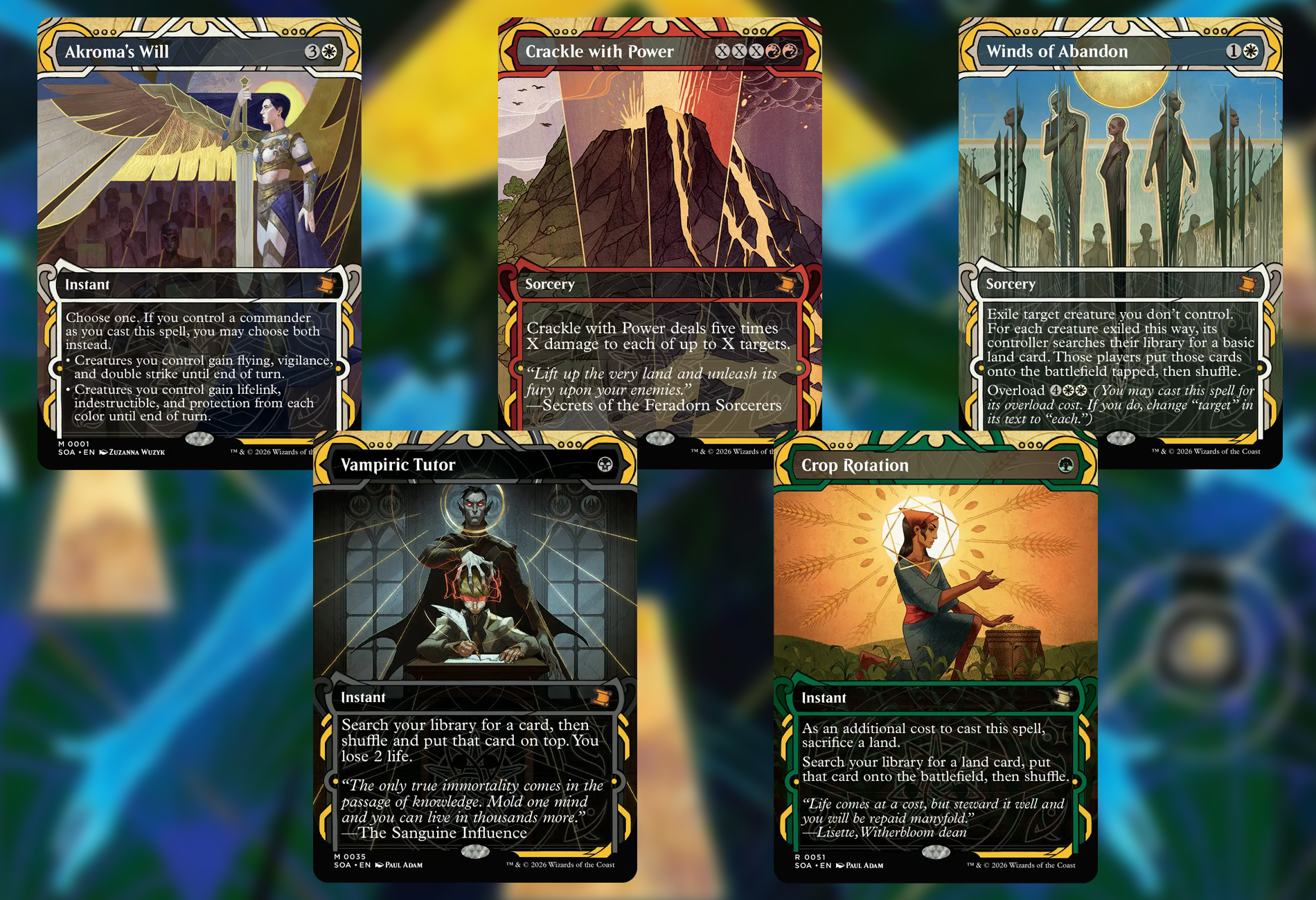
On the other hand, cards like Vampiric Tutor, Pyretic Ritual, or Crop Rotation are traps. They may have been Constructed all-stars, but in Limited they lead to card disadvantage and typically fail to generate enough immediate impact to justify their inclusion. Similarly, symmetrical haymakers such as Armageddon, Smallpox, or Living End are difficult to exploit effectively and are often better left in the sideboard unless your deck is specifically built to break them.
Even the theoretical appeal of assembling a combo like Angel’s Grace plus Ad Nauseam is tempered by the reality that both pieces are weak on their own and that it’s difficult to actually win the game after assembling the combo.
Sweet Combos
Some two-card interactions in this Limited format do more than simply add up their parts. When hey come together, they can feel like discovering an answer key tucked into the margins of your exam paper. Let’s look at a few of the more elegant examples.
In Limited, 12 mana is enough to turn Mathemagics into a genuine win condition. If you can force your opponent to draw 32 cards, they are almost certain to deck themselves on the spot. A sequence of turn-four Resonating Lute into a turn-six Mathemagics for X=5 makes this two-card combination worth serious consideration, at least if you happen to open both the mythic rare and the rare.
A more realistic combo between two Uncommons emerges when you activate Charging Strifeknight and discard Summoned Dromedary to draw a card. This sets up a recursive line where you can return Summoned Dromedary on the following turn and activate Charging Strifeknight once more, effectively drawing a free card for two mana. You may even trigger Lorehold-themed cards like Spirit Mascot along the way!
Finally, if you control both Informed Inkwright and a prepared Spiritcall Enthusiast, you can cast Scrollboost, create a token with Informed Inkwright, and re-prepare Spiritcall Enthusiast. This creates a repeatable engine where each two mana invested produces a 1/1 token while simultaneously boosting your board. Left unchecked, this quickly takes over the game.
Top Single-Color Commons and Uncommons
Earlier in this article, I highlighted some of the set’s most powerful higher-rarity cards, including Germination Practicum, Akroma’s Will, and Together as One. However, the true backbone of any Limited deck is still built from commons and uncommons. Let’s look at some of the strongest single-color options you will be happy to include in your deck.
At the top of my mono-color uncommon rankings sit Environmental Scientist, Matterbending Mage, and Foolish Fate. Each offers card advantage, board presence, or tactical flexibility at highly efficient mana cost. They may not always be flashy, but they are consistently reliable, the kind of picks that fit comfortably into every archetype.
For commons, my shortlist of the six best in the set includes Elite Interceptor, Eager Glyphmage, Send in the Pest, Last Gasp, Unsubtle Mockery, and Noxious Newt. Three of these provide clean removal or efficient board presence: Eager Glyphmage, Last Gasp, and Unsubtle Mockery.
The remaining three would be fine early drops in any Limited set but particularly stand out for their synergy potential. Elite Interceptor helps unlock Repartee, Send in the Pest enables Infusion, and Noxious Newt accelerates your mana to support Increment strategies. These commons form the foundation of the format.
Which College to Choose at the Prerelease?
When you register for a Prerelease event, you will receive five Secrets of Strixhaven Play Boosters and one Secrets of Strixhaven college-themed booster. Each college-themed booster contains cards from among that college’s two colors, naturally nudging you toward building a deck in those colors. Some local game stores will assign Prerelease Packs at random, while others let you choose your college. This leads to the inevitable question: which school is the strongest, and which is the weakest, in Secrets of Strixhaven?
It is difficult to guess before playing with the set, but my initial evaluation looks like this:
- Silverquill > Witherbloom > Lorehold > Prismari > Quandrix
White and black appear to offer a deep pool of high-quality commons, making Silverquill the most appealing starting point. By contrast, blue looks comparatively weaker. I did not select a single blue card among my top six commons, and both Prismari and Quandrix rely on more top-heavy game plans that may struggle to establish early footing. For that reason, I have placed the blue colleges at the bottom of the list.
Witherbloom and Lorehold both lean heavily on synergy, requiring multiple pieces to function at full strength, such as life gain plus payoffs or graveyard interaction plus enablers. This makes them somewhat inconsistent, but when the pieces come together, they can be extremely powerful. Between the two, the Witherbloom curve of Bogwater Lumaret into Pest Mascot into Grapple with Death looks stronger to me than the suite of Lorehold gold commons. Combined with black’s excellent single-color commons, I ranked Witherbloom second and Lorehold third.
That said, I may still choose Quandrix at my own prerelease because I love mathematics. Any college can produce a viable deck, and the differences between the color pairs are small, so there is no wrong answer for what to pick. Prerelease events are welcoming, social experiences, and the most important goal is simply to enjoy the format and select a strategy that matches your personal playstyle.
Conclusion
Secrets of Strixhaven Prerelease events are happening this weekend at your local game store! No matter what year of Magic studies you find yourself in, this is your opportunity to step back onto campus alongside your local gaming community.
And for a final touch of university flair, check out Ultimate Guard’s newest line of playmats, Zipfolios, and Sidewinders, featuring officially licensed Magic: The Gathering artwork from Secrets of Strixhaven!