

Affinity for Pauper: How to Choose Decks for Big Tournaments (Plus a Full Deck Guide for Grixis Affinity!)


Pauper is a format I’ve played in the past, both in paper and online. One of the biggest differences I’ve noticed is time management: on MTGO you have your own clock, while in paper tournaments, the time is shared between both players. This becomes a big issue if your pet deck is a very slow, grindy strategy with very few win conditions (sometimes including the opponent’s natural mill), like BG Gardens.
Sadly, this is my case. Even though I know how to play quickly and often have to encourage my opponents to do the same, for this event I decided to play a less stressful kind of Magic and focus on something else.
The format is huge, right?
Step One: Format Analysis
I won’t spend too much time on this section, you can read more about the Pauper meta game and the decks to watch ahead of Paupergeddon here! But briefly, this is how I see it:
Monocolored decks are playing a rock–paper–scissors dynamic:
- Burn (R) almost always beats Elves (G) but usually loses to Terror (U)
- Elves beats Terror but loses to Burn
- Terror beats Burn but loses to Elves
With the printing of TNMT, a new monocolored challenger entered the format: Mono-White, playing Leonardo, Big Brother. This card is insane in swarm strategies, especially if you’ve already cast Battle Screech, and it synergizes very well with Kor Skyfisher, which can bounce it and set up a huge amount of damage on the next combat step.
The rest of the format mostly consists of random decks with terrible manabases or weak cards. Since I’m the self-proclaimed king of weak cards (trust me: I registered Psychic Frog during the Nadu and Breach meta), I once again tried to play my pet deck: UR Skred.
Oh boy...

Skred is one of the coolest Magic decks in Pauper, but it’s also very weak. You rely on seeing the right mix of threats and payoffs at the right time, and most of your interaction is based on one-for-one trades, often even trading down on mana.
The amount of cantripping you do isn’t enough to compete with engines like Ichor Wellspring + Deadly Dispute, and you often end up falling behind because while you’re cantripping, your opponent is developing their board.


I had decent results at the last Paupergeddon, where I played Skred, going 7–1 and 8–1 in the side events, followed by a soul-crushing 4–3 in the main event. However, I feel that against 2026 decks I simply won’t stand a chance.
Pro tip I learned from playing competitive events: If you play a deck where, even with the perfect opening seven and the best possible three draw steps, you still can’t produce a lethal threat by turn three (or turn four for Pauper’s power level), your deck is probably bad.
And that’s fine! You can absolutely play a bad deck. But you’re significantly lowering your chances of winning the event.
Step Two: Locking on a Deck
After trying Skred, as well as five or six other decks, I really pulled out the worst brews possible, without finding any success, I decided to think in reverse.
- What do I expect to be popular?
- What do I really not want to play?
- What do I like to do?
I expect, as always, a ton of red decks, around 20%. It is clearly the best deck; it won the last Paupergeddon, and it is putting up strong numbers online. Then I expect Mono Blue Terror, around 20%; it is the counterpart to red, and people really love playing Counterspells.
The rest is much harder to predict. I usually expect Jund, a very “Italian” deck, but I do not think the deck is in a good spot right now. I expect some Elves, but the matchup against red really discourages non-Elf players from playing it. In addition, there are many committed players who stick to their pet decks, and that makes things difficult to predict. I will call the remaining 35% "other decks".
I really did not want to play one of the monocolored decks, because when I tested them, I had no idea how to break the rock-paper-scissors dynamic. The Mono White deck seemed like a solid 3-2 deck, but it had major inconsistencies and a big target on its head right now.
I like to draw cards, play powerful spells, and play tempo strategies.
The obvious choice was Affinity, a deck I have played in the past that recently received a new and expensive toy, Utrom Monitor. I had fourteen days to test the deck, and since Affinity is traditionally a very complex archetype, both in deckbuilding and sequencing, I decided to soft-lock myself into it and only play it for the rest of the testing period. If things really do not work out, I can still switch to BG Gardens at the end.
Pro Tip: Saving time is important, and in a "solved format" like Pauper, it’s much more relevant to use your time to learn the perfect ins and outs of what you’d end up playing than stressing too much with deck selection.
Pro Tip: Always have a pet deck you can lean on if things go super wrong. Usually, playing the best deck with no preparation is not a wise choice, unless the best deck is Nadu or your MTGO name is Thalai.
Step Three: Tuning the deck
My personal three steps to tune a deck are:
- understanding good and bad cards
- understanding the numbers
- matching maindeck and sideboard numbers so that you (almost) never have dead cards in the maindeck
First Step:
I can divide this process into two different areas:
- cards I want because they’re actively good
- cards I want because they help me not die
For Affinity specifically, a classic example is: Utrom Monitor is a busted card, while counters are cards that prevent you from randomly losing.
Let’s focus on the good cards. After playing ten matches with the deck, I realized Utrom Monitor is good enough to justify playing four copies. The card is awesome at helping your tempo game plan become more aggressive. It’s huge in multiples and plays very well with all the cards in your deck, both creatures and noncreatures: remember you can Reckoner’s Bargain your Utrom to gain back 5 life.
An additional value provided by Utrom is that you finally have a way to block annoying flyers such as Kor Skyfisher or Sneaky Snacker.
Another card I really enjoyed is Sewer-Velliance Cam. This cute one-mana artifact is insane, since the deck often ends up in racing situations where tapping a blocker can be huge. It can do it twice, drawing you an extra card in the late game, but you can also sacrifice it with any dispute effect to tap another creature. Also, remember you can even untap one of your creatures to ambush an attack.
Other cards that impressed me are Blood Fountain, which is especially helpful with Utrom, and Nihil Spellbomb, since it’s relevant against all the decks in the format.
The rest had already been discussed. I tried various matches without Familiar, Krark-Clan Shaman, and Myr Enforcer, because I feel each of these cards has a liability. The testing helped me realize how important each piece is, and what the best way to capitalize on them is.
After I understood which cards I wanted in my main deck, I had to consider what to put in my sideboard, trying to find the best cards to help me “not die”.
Here’s my reasoning:
Right now, there are three problematic cards for Affinity:
Dust to Dust is the scariest one, since it’s often a one-sided Armageddon in postboard games. But it’s also only a sideboard card, and I realized that I often win game one because my deck mulligans well, has a fast strategy, and extra reach. Even against Mono-White, I often found myself on the draw in game two, meaning I needed an answer that costs one mana, considering Negate might be unreliable at times with Affinity’s silly manabase.
I found Envelop to be the perfect answer for Dust to Dust, mostly because it’s also a cool card to have against Spy and other sorcery-based matchups. I started winning a lot of postboard games this way, even beating the second Dust to Dust by grinding resources.
Masked Vandal is annoying because it’s a Sinkhole attached to a creature, and it’s often game over in multiples. Any green deck runs the playset in the main deck. My way to edge against Vandal is running Nihil Spellbomb in the main, often sequencing it in the first turns of the game. Trading Spellbomb for the Vandal effect is often okay, especially if you can draw a card in the process. Remember that if your opponent is smart, they can always cycle something at instant speed in response to the Spellbomb activation, so sometimes it’s better to let it go.
For this reason, specifically against Spy Combo, I am playing an additional Faerie Macabre. The games tend to go very long, and I found myself drawing more than half of my deck before randomly losing to multiple Vandals plus the combo. Macabre helps in those spots, and if you have a Shaman on the battlefield, they have almost no ways to beat it (the only way would be stealing it with Mesmeric Fiend).
Writhing Chrysalis is the strongest Pauper card ever printed, and while it’s a “fair” card, it’s a nightmare for Affinity. It’s bigger than any creature I play, and having reach means it can immediately stop the race even if I have two Myr Enforcers and one Utrom.
Preboard against Chrysalis decks there are two outs: a fast clock plus Sewer-Velliance Cam, or KCS + Toxin. Once they’re at 8 life or less, the game should be winnable since there isn’t much lifegain in the maindeck, and we have four Blasts plus Munition.
Postboard games are definitely slower, more grindy, and full of interactions. I like to have two Cast Down to immediately remove the problem and keep the flying race going. I also pack two Metallic Rebuke to edge against turn-four Chrysalis, but the card is really versatile at countering removal or Troublemaker Ouphe.
Second/Third Step:
After the selection process, I liked all the cards a lot. I realized I really wanted to play three Nihil Spellbomb in the maindeck, mostly because I was siding it against almost every deck in the format, so keeping it in the sideboard felt like a wasted slot. Plus, it’s an easy -3 in the rare cases where the card isn’t brilliant (let’s say against Gardens and Faeries).
Krark-Clan Shaman is the most perplexing card, but after speaking with multiple experts, I decided to trust them and register three copies in the main. The card is just absurd when it’s good, and often you need to find one in the top ten cards of your deck, otherwise you’re dead. The third big reason is that I feel Elves will be overrepresented at Paupergeddon, and the card is really strong against it.
I tried three Blood Fountain, and while the card is always okay, I found myself happier with two. You spend your mana very efficiently on each of your turns, which makes the third Fountain often not good enough or an easy sideboard out against aggressive decks.
I liked Hunter’s Blowgun in my testing mostly because it gives you some flow to deploy your threats earlier, but I found Toxin Analysis to be a much better card overall, and I couldn’t justify registering just one copy. Toxin + Krark-Clan Shaman is just an absurd combination (boomers might say Splinter Twin), and gaining some life back after falling behind on board is what ultimately convinced me to include it.
Plus, the life gain is always relevant in a meta where I expect about 20% Mono-Red, and Toxin Analysis is basically a limited combat trick that sometimes ends up being powerful enough even in Constructed. I also like to keep a mental note of -5 cards when I side out the KCS package, having the possibility of siding 5 cards. These small reasoning that started when I ran down the numbers in this stage of testing, helped me a lot building my sideboard properly.
I applied the same approach to my sideboard. Since I was working with “packages” of four to five cards, for example KCS plus Toxin, two Sewer-Velliance Cam plus Makeshift Munitions plus interaction, or four Galvanic Blasts, I focused on organizing the sideboard into small groups of four to five cards, and tried to avoid boarding more than that.
For example, I have four Hydroblasts that replace one-mana interaction like the Cam, or four Pyroblasts that replace Galvanic Blast.
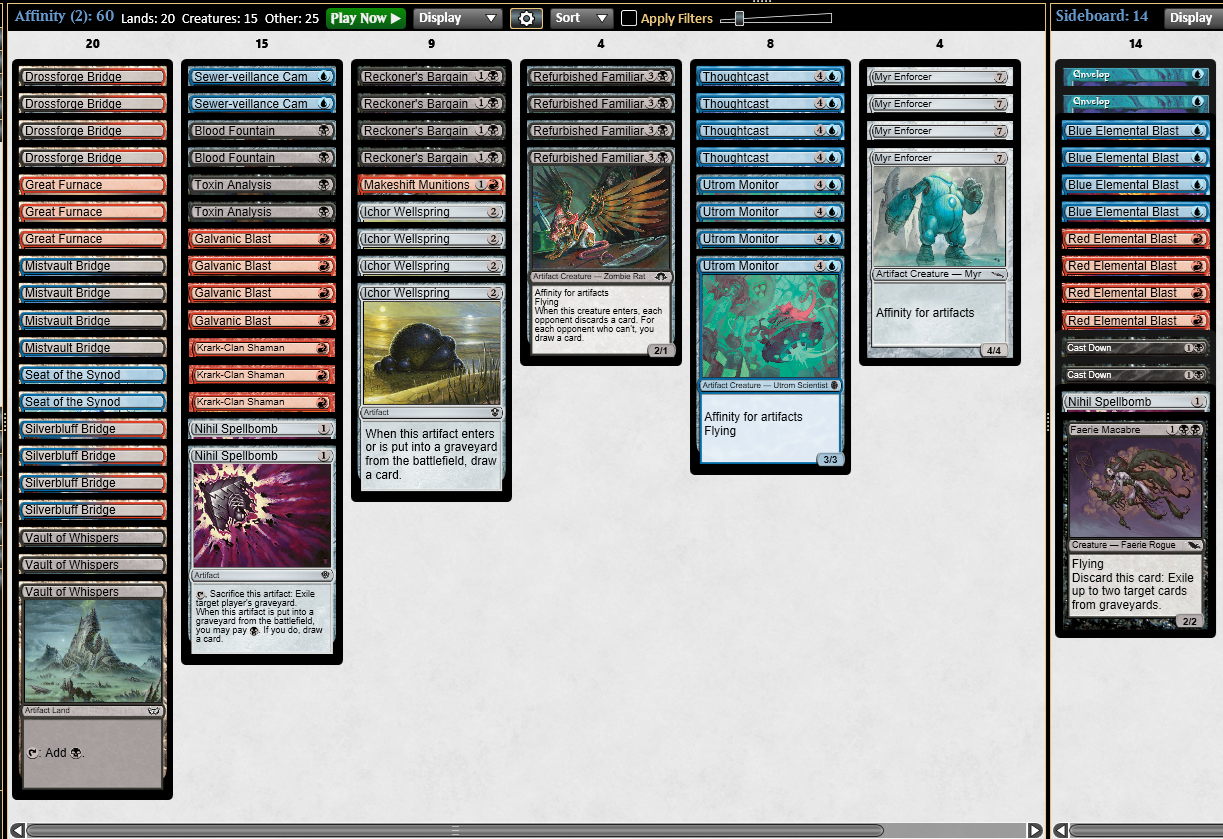
After this step, my deck looks like this:
-
4Drossforge Bridge
-
3Great Furnace
-
4Mistvault Bridge
-
2Seat of the Synod
-
4Silverbluff Bridge
-
3Vault of Whispers
-
2Sewer-veillance Cam

-
2Blood Fountain

-
2Toxin Analysis
-
4Galvanic Blast

-
3Krark-Clan Shaman
-
2Nihil Spellbomb

-
4Reckoner's Bargain
-
1Makeshift Munitions
-
4Ichor Wellspring

-
4Refurbished Familiar

-
4Thoughtcast

-
4Utrom Monitor
-
4Myr Enforcer

-
2Envelop
-
4Blue Elemental Blast
-
4Red Elemental Blast
-
2Cast Down
-
1Nihil Spellbomb
-
1Faerie Macabre
Pro tip: Divide your testing into three sessions!
- First, test all the cards and try to understand what’s good and what’s bad. Don’t be scared to go against common sense: try adding or removing cards that everyone else is playing.
- Second, once you have a good grasp of the cards you like, try to understand how many of those cards were actually relevant to winning, or whether you lacked any particular cards. For example, after losing three game ones that I would have easily won with KCS, I decided to run another copy in the main deck. If you have any doubts, try to understand on which turn a card is good, how much mana or how many resources you need to optimize it, and how many similar cards you already run. For instance, if you’re already playing eight or nine draw spells but you lack threats, you might want to add an extra threat to make your game plan more cohesive.
- Third, think in numbers. I usually write down a list of matchups and figure out my ins and outs for each one by noting how many cards I want to remove from my maindeck. Then I try to understand which cards are good in that matchup and whether there’s a way to fill the gaps.
For example: if I have six good cards in the sideboard for a matchup but only five cards I want to remove from the main deck, I ask myself a question. Can I move the sixth sideboard card to another matchup where I’m short by one card? Or do I need to find a card in my maindeck that I’m willing to shave?
Maybeboard
As you might have noticed, the proposed decklist contains only fourteen sideboard cards. I usually don’t stress too much about the last slot, as I strongly believe that you only need seventy-two out of seventy-five cards to win a tournament, meaning that you are playing the right deck and playing it well.
That said, here are some candidates for the final slot to complete the puzzle:
- Gorilla Shaman: only really good in the mirror, and in a few specific spots, but likely worth it since I expect a lot of Affinity.
- Thorn of the Black Rose: a strong value engine against Jund, the mirror, and Familiars.
- Arms of Hadar / Krark-Clan Shaman: very strong options in a metagame full of monocolored aggro decks.
- Metallic Rebuke: an unexpected one-mana Mana Leak, decent against slower midrange decks and white-based strategies.
Tips & Tricks
Before getting into the sideboard guide, which is the final result of my testing, I want to share a few key tips you might find useful when playing Affinity. Most of these come from losing a lot, trying different ideas, and refining my play over time.
1) Never keep one-landers, unless you’re on four cards
Hands like Vault + Blood Fountain look tempting, but they consistently underperform. Even if you hit your second land and deploy a threat, it’s not guaranteed to stick, and you can easily miss your higher-cost cards, leading to a non-game.
2) Pressure vs value
A common decision with Affinity is whether to tap out for a threat or wait and hold up Dispute. There’s no universal answer. Evaluate your board, consider what removal your opponent might have, and whether it benefits them to interact or develop. Your threats scale much better in multiples, so it’s often correct to wait a turn and deploy two in the same turn, especially if you’re holding a bargain effect.
3) Don’t overthink, think efficiently
The manabase is fragile, and it’s easy to become overly focused on cards like Dust to Dust or Cast into the Fire. This shouldn’t push you into mulliganing solid hands without countermagic, or keeping weak ones just because they have protection. Instead, evaluate the worst-case scenario and accept it. Many of these hate cards are beatable, especially if they are not backed by pressure or if you can rebuild quickly. Prioritize keeping hands with three or more lands when possible.
4) Count your mana, plan ahead
With 11 to 12 taplands and mostly one-drops, mana planning is critical. Take the extra time to sequence your turns correctly and avoid committing to a land drop too early. Land sequencing is one of the most important skills with this deck, and small mistakes here can easily cost you a full turn.
5) Stay engaged, avoid autopilot
Affinity rewards active thinking. Every game, every turn, try to reassess your options based on what your opponent has shown. Even small adjustments in your decisions can have a big impact on the outcome.
Sideboard Guide
If you have a different sideboard, remember the most frequent cards to cut are Sewer-Velliance Cam, as the card is not huge against aggro decks, and Makeshift Munitions unless you’re planning on going super long / kill a lot of 1/1s.
Never cut Thoughtcast or more than 1 threat.
Madness:
+4 Hydroblast
+2 Envelop
-2 Sewer-Velliance Cam
-3 Krark-Clan Shaman
-1 Makeshift Munitions
Terror:
+4 Pyroblast
+2 Cast Down
+1 Nihil Spellbomb
-4 Galvanic Blast
-1 Makeshift Munitions
-2 Sewer-Velliance Cam
Mono White:
+2 Envelop
-2 Sewer-Velliance Cam
Elf:
+1 Nihil Spellbomb
+2 Envelop
-2 Sewer-Velliance Cam
-1 Reckoner’s Bargain
Mirror:
+1 Nihil Spellbomb
+2 Pyroblast
+2 Hydroblast
-3 Krark-Clan Shaman
-2 Toxin Analysis
Caw-Gates:
+4 REB
+1 Envelop
-2 Krark-Clan Shaman
-2 Toxin Analysis
(Side accordingly to what you see. Envelop is good against Dust to Dust, but useless if they don’t have it).
Familiars:
+4 Pyroblast
+1 Nihil Spellbomb
-1 Makeshift Munitions
-2 Sewer-Velliance Cam
-1 Toxin Analysis
Red Rally:
+4 Hydro
-2 Sewer-Velliance Cam
-2 Nihil Spellbomb
BG Spy:
+1 Nihil Spellbomb
+2 Envelop
+1 Faerie Macabre
+2 Cast Down
-1 Sewer-Velliance Cam
-1 Makeshift Munitions
-4 Refurbished Familiar
Thanks to Team Wizard’s Cottage for helping me understand and tune the deck. If you have any questions, feel free to check out my Twitch, where I stream every day, or reach out to me on Instagram.
PieGonti