

Which MTG Color Am I? All Colours and Guilds in Magic Explained


Magic: The Gathering has a special resource system, where you include your resource cards within your deck, as they are a part of what you draw during the game. Those resources are in the form of Lands, and they can produce mana of specific colours, of which Magic has five: blue, black, red, green, and white.
While this is crucial in the context of casting spells, the colours of MTG are much more than just different shades for the sake of complicating playing your cards. On the contrary, each colour carries with it a unique set of characteristics to the point that if you showed someone the cost of a card, they could very well narrow down what the card can or cannot do.
In today's piece, I want to delve into the world of what colours in Magic do, what playstyles they promote, and what cards they are typically associated with, alongside with key two-colour pairs that are used across every format of MTG.
The Colour Wheel
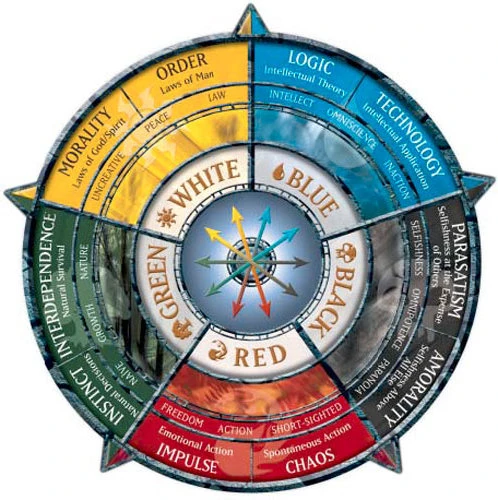
As I said previously, Magic has five colours of mana: blue, black, red, green, and white. Each of those colours has its own characteristics, identity, and flavour. This is a crucial part of MTG as a game and its success over the years. A simple resource system turned into a feeling of belonging. If you've ever conversed with a Magic player, statements like 'she loves blue' or 'he's more of a red player' are a daily occurrence - and that's for a good reason! Each colour promotes specific gameplay and strategies that some players tend to enjoy more than others.
Magic design is trying to adhere to those characteristics set by set but sometimes a card is released that doesn't seem to work within our conceptions of the colours of MTG - such a phenomenon we'd call a colour pie break. It's pretty rare, but sometimes if done often enough in the same way it expands the original identity of a colour. I will delve deeper into each individual colour later, but just to give an example now.
Feed the Swarm is a black card that:
- destroys a creature
- destroys an enchantment
- loses you life
Two out of three are perfectly in line with what you'd expect Black to do but...the middle effect is very out of character. Black, for all intents and purposes, cannot deal with the enchantment card type - and yet here we are. This is still considered just a pie break, as black hasn't (yet?) gained the identity of being able to remove enchantments.
It wouldn't be realistic to only use single colours to describe the decks people play, as it's rare to actually see mono coloured strategies. The vast majority of decks throughout Magic's history have been two colours - combining the characteristics of both. When original Ravnica was released in 2005, it got solidified much more strongly into specific naming conventions of those two-colour pairs we have since called Guilds.


While you could shorthand the identities of each guild as a combination of the characteristics of the colours that make it up, because of Ravnica, we have very specific associations of what specifically those Guilds represent - which you will often see manifested in products such as Commander Preconstructed decks that feature a given colour pair.
That said, let's get into those aforementioned characteristics!
The Colours of Magic
Blue
Blue is the colour of knowledge, curiosity, and intelligence. It acts with intent, methodologically, trying to work out solutions to difficult problems.
It's infamous for being the only colour that wields Counterspell effects - a way to say 'no' to anything on the stack. This counterspell identity comes at a severe cost, as blue doesn't have good removal at its disposal, putting it typically in a spot where it either has a counterspell or it's in big trouble. It is, however, known for 'temporary' answers to problems, using so-called bounce or Return to hand effects.
Blue is also a colour of card draw and card selection. If you like to manipulate the library, sculpt your hand, filter your draws, and rely less on what you happen to draw, this is the colour for you.
It's not a purely control colour, though. It utilises numerous creature-centric characteristics like combat trickery (such as Ninjutsu), flying and unblockable keywords, and tapping permanents.
White
White is a colour of law and peace. It values structure and equality. It is selfless and puts value in the community.
There is no one thing that it's particularly famous for, as it's a pretty multifaceted colour. It has great point removal *and* is well known for its mass removal effects.
It is also the colour of small creatures that, in the spirit of the colour, are better together and feed off some synergies between them.
Moreover, it's great at removing problematic permanents such as artifacts or enchanments.
Last but not least, if you want to gain life, this is the colour to do it.
Red
Red is the colour of raw emotion and impulse. It's acting spontaneously, putting its freedom of expression first. It's also a colour of destruction and chaos.
Red has two main qualities which complement each other very well - small and fast creatures, and direct burn damage. It contributes to red ending games fast.
It is also great at dealing with artifacts and lands, while lacking in answers to enchantments.
It also uses threaten effects to temporarily gain an opposing threat and use it to its own advantage.
Furthermore, it wields a ton of combat-relevant mechanics to aid it in the red zone: trample, double strike, prowess, haste, and many more.
Green
Green is the colour of nature. With it comes spirituality, connection to the earth, and tradition. It coexists with the natural order of things, the beauty of life as it is.
Here, you can find a lot of permanent mana acceleration in the form of either early creatures that grant mana or ways to find more lands.
You also get to play creature tokens and multiply them, particularly big creatures, especially with the trample mechanic.
Green also excels at winning combats through pump spells - ways to suddenly increase your creatures in size.
Black
Black is the colour of death - it worships it, but it also takes advantage of it. It's also a colour of self-interest and sacrifice, preferably of others. It wants to gain power through any means necessary.
Colour likely best known for its capacity to remove obstacles - it absolutely excels at killing opposing creatures.
It also uses the graveyard to gain additional advantage over the course of the game in numerous ways - most notably by reanimating what has already died.
A lot of black cards will emphasise the sacrifice element which will come in the form of direct downsides to your cards such as you having to lose a creature or pay life to achieve something.
Guilds
Now that we know what each colour is about, we can analyse what each colour does best, what it lacks, and pair them up to get the best of both worlds!
Azorius
Azorius is the guild of law and peace - with that small caveat that it will bend the law to its own advantage. It's lawful within the rules it's creating itself.
This is historically the most control colour combination, since both colours bring something important to the table - blue brings counterspells and draw, white brings point and mass removal. Azorius immediately makes one thing of games going long and you getting either everything countered or killed.
There are non-control archetypes within Azorius, as both colours also have strong creature identities. You can see strategies like Azorius Tempo or Azorius Flyers, comprised of small creatures, typically with evasion, some removal, and counterspells whose goal is not to stop the opponent per se, but to protect your own aggressive plan.
Dimir
Dimir is sneaky, it's deceitful - and it's far from trustworthy. It's going to use its trickery to turn the situation to its advantage. Dimir mages influence the minds and gain information.
While Dimir can be a strong control colour with blue's counterspells, and black's removal, both elements are often seen in tricksy Dimir creature strategies that typically revolve around some creature type for synergies like Rogues or Ninjas.
They often use necromancy to power up their gameplan with the help of blue card selection and black reanimation effects.
Izzet
This is a guild of geniuses who come up with the most ingenious solutions to the problems at hand. Creative intellectuals with a lot of aces up their sleeves.
There are three main identities of this colour pair.
- Artifacts synergies
- Izzet is great at harnessing the power of artifacts by both creating them and using their synergies.
- Big spells
- With discounters and mana-adding rituals, you can power out insane spells in a single turn.
- Spell-slinging
- Izzet will enable playing numerous spells in a single turn thanks to discounters but also benefit from more than one spell cast each turn
Since red removal is mainly good against smaller creatures, blue-red is not such a strong control combination, despite having access to blue.
Simic
Simic is trying to creatively combine what's natural with what humans can produce to enhance it. Its biomancers adapt, improve, and mutate.
Since both green and blue aren't colours of removal, Simic won't be the most controlly combination. What it will be though is a combination focusing on value creatures, ramp, and lands.
You can build Simic as a ramp deck where you power out a big creature early, especially with scaling X costs. You can also focus on lands and what they can do in addition to generating mana. Simic also has access to creatures that generate an advantage when they enter play - typically drawing a card.
Simic also loves +1/+1 counters and what further synergies this enables.
Gruul
Gruul smashes, raids, and destroys. It's angry and large.
This is the perfect colour combination if you like attacking, especially with big hasty creatures. Gruul ends games *fast*.
It will use red to kill creatures in its way but will also happily target the damage directly at the opponent's face. Gruul creatures are also hard to block since they will outmuscle the opposition and have in-combat mechanics like trample.
Selesnya
Selesnya is good and peaceful. Selesnya is community-loving, and nurturing.
This colour combo is great at token generation - if you like to go wide, and make a huge army, this is the guild for you.
Moreover, it uses the enchantment type to its advantage quite a bit - creating strategies revolving around putting Auras onto your creatures to make them stronger.
It's very versatile when it comes to the way you build your offence - a lot of small creatures, one big creature, a middle-size army with +1/+1 counter synergies, and much more.
Golgari
Golgari balances life and death - as per green and black in its identity. Growth comes from the circle of life - but it is indeed a full circle; from life to death and from death to life again. It's a single organism composed of numerous single entities.
Golgari is a guild that loves to use the graveyard to its max potential. Why use a card or effect once, when you can re-use it again. A lot of effects in this guild will care about the number of specific types in the graveyard, the raw number of cards, or specific abilities that only work if they are there.
Naturally, it's great at reanimation but also at putting cards in the cemetery.
It also has a couple of sub-themes like swarms of creature tokens (like Pests or Insects) and lifegain.
Rakdos
Rakdos is demons and occultism. It's pain and suffering for entertainment. Pleasure-seeking hedonists with utmost cruelty.
Rakdos combines red and black, giving it a ton of tools to make sure an opposing creature doesn't stay alive too long. It also makes up for a very explosive combination that lends itself to more aggressive strategies, whose sole aim is for the opponent to lose life.
Boros
Military guild that believes in doing good and bringing harmony to the world - even if through combat. It's righteous in what it fights for!
Boros is an aggressive colour combination, borrowing from its colours - white's small creature aspect and red's fast creature aspect. In tandem, it creates a cohesive army that will end the game in a heartbeat.
The main strength of Boros decks isn't individual card quality, though. It's about the whole army and how the soldiers motivate and mentor each other to achieve something that's greater than the sum of its parts.
Orzhov
Orzhov is a religious oligarch group that holds high capital and penance. It's unscrupulous, usurping, and extravagant.
Orzhov decks, thematically to the wealthy nature, are often of the Aristocrat variety. They warp the plan around sacrificing a lot of small, disposable creatures, all the while gaining some advantage like life or cards.
This colour combination has got great removal, life gain (which is particularly useful at offsetting the black's life loss), powerful creatures, and reanimation capabilities.
Conclusion
As you can see, there is much more under the surface than just the colours you need to pay for a spell. It's a whole branch of lore that's exciting to explore.
And which guild are you, my dear reader? Let me know!