

Riftbound Limited: Rules and Tricks for Playing Sealed



Riftbound Limited Rules
First off, we start with how Limited differs from the normal rules of Riftbound, because there are some critical differences between normal play and limited play.
Deck size: The Main Deck has to be a minimum of 25 cards. There can be more, but not fewer, in the deck.
Domain restriction: We can use up to three different Domains in our deck. There are no other restrictions. If we use a Signature Spell, we have to use both colors of that spell, not just one.
Copy Limit: There is no copy limit of cards you can use. If you opened 6 of a certain card, you can play all of them.
Rune Deck: The Rune Deck still has the same size of twelve. Keep in mind that playing more Domain colors will lead to fewer Runes of a certain color, so keep your power usage in check while building your deck.
Champions & Battlefields: While we can’t guarantee that we'll open some in our boosters, these are flexible. We can play with a Champion, which has to have both colors of our domain again, or certain Battlefields we open. Neither is mandatory and will be replaced by blanks. But there is a benefit: if you don’t use a Legend card or even a Champion Unit from your deck at the start of the game, you get to draw an additional card in your starting hand. This will mitigate the fact that you don’t open a Legend or even a Champion Unit in your colors.
How to Build a Sealed Deck in Riftbound
This was a short overview of the differences between regular and limited play, and now onto building our Sealed Pool. For that, I opened 6 boosters of Spiritforge, the second set of Riftbound.
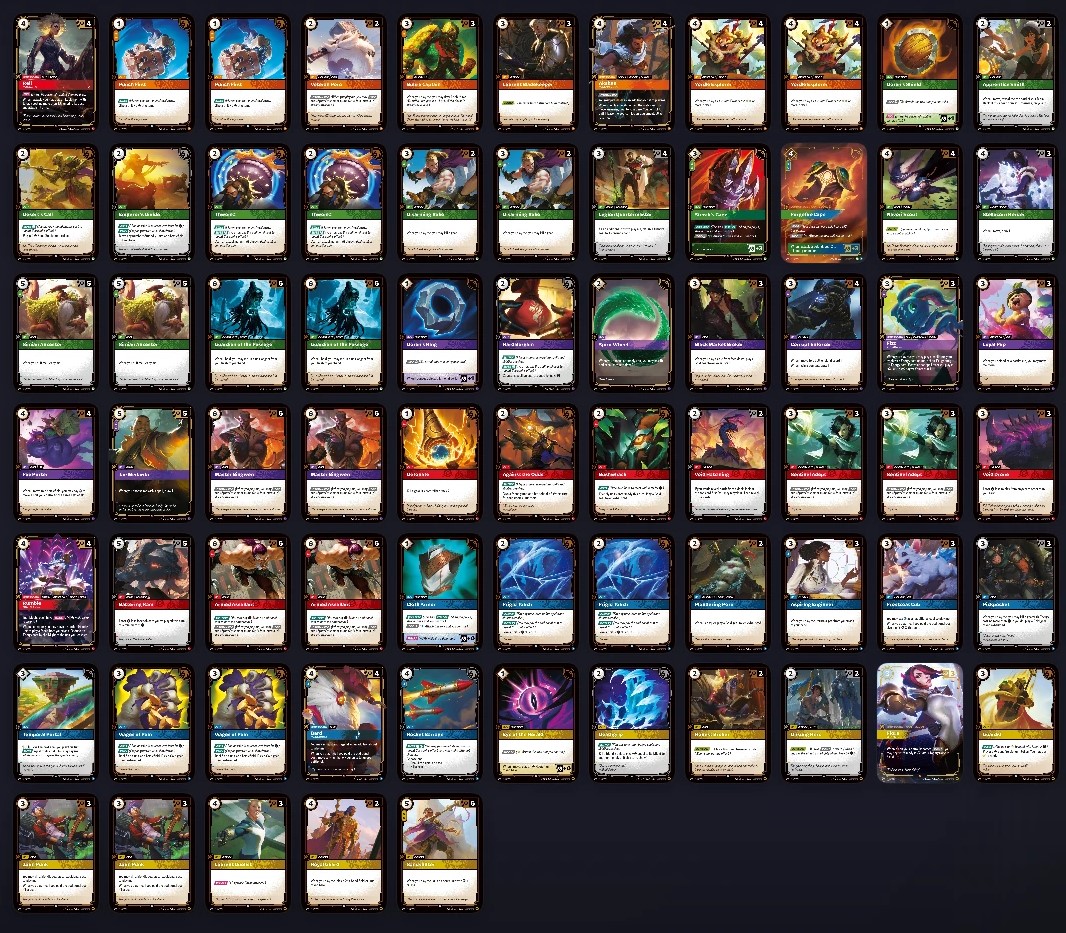
Additionally to these cards, we opened 3 different Legend cards: Chem-Baroness, Renata Glasc; Battle Mistress, Sivir; and Fire Below the Mountain, Ornn.
Battlefields we have access to are the following: Hall of Legends, Ornn's Forge, Marai Spire, and Veiled Temple. But first, let us take a look at our pool and figure out which are the strongest and most impactful cards we have.

These are some of the cards that stand out for me:
Red has some good units with acceleration and Weaponmaster, paired with a very good trick in "Against the Odds" and Rell if we can abuse her ability to cheat some extra equipment into play.
Blue has some decent early-mid game removal, which can be paired with other tricks in the late game, which can come quite in handy for dealing with bigger units.
Orange has a very good Champion Unit with Akshan and two "Punch First," which are power-heavy but let you win almost any combat, which is very good.
In purple, only Fizz stands out, but this card is a powerhouse on its own if you have some really good spells to recast out of our trash, and he is someone we can put in our Champion Zone so we will always have access to him when we need it.
And in my opinion, the best color we have is Green. Two good green equipments, even though one needs us to play blue as well, but the effect is really strong. One very strong movement card that can lead the opponent to overextend in spells, and when you safely move out, we get to conquer it the next turn when our opponent is out of gas and Runes most likely.
Last but not least, we have good value cards in the form of constructed all-star Stellacorn Herder and some decent Guardian of the Passage that can provide value as well.
With this information, I would have built something like this:

With this build, we play our best cards combined while only using power from two different colors. We also have some decent gold creation, and are very low on early game power usage if we really want. We have a really good unit to champion in Akshan and have an overall very good curve in units. We also have some decent ways of making value with the Yordle Explorer and Stellacorn Herder, while also getting some tempo with cheap Punch First.
Overall, a very good look. Also, we can include Ornn, Fire Below the Mountain, as our Legend if we want the discount on some equipment usage, which is very useful, and in combination with our value, we generate an overall well-balanced deck.
Written by Joshua Bausch