

The ultimate guide to the Hide 'nd Sneak Archetype: All you need to know



Hello everyone!
When the first cards from the latest set, Pitch Black, were first revealed there was a group of Pokémon that caught everyone’s eye right from the start (and of course, that includes me): Hide ‘nd Sneak. It is not the first time that Pokémon Company has released an archetype that focuses on psychic or ghost-type Pokémon that get more powerful the more comrades you have in the discard pile. However, success has varied a lot, from decks like Night March (2016) that absolutely defined the meta of their time to some other strategies like United Wings (2023), which were never able to move beyond the “rogue” category.
It is clear that this dynamic is a fan favorite and if we acknowledge the fact that the format has a very real issue with deck variety, it is normal that players want Hide ‘nd Sneak to be good. But making the deck work is not always easy, as it requires a lot of cards to actually function and there is no consensus among players on what the best build looks like. So if you, like me, are obsessed with little guys that become a menace by discarding friends and want to learn everything about this very unique deck, this guide is for you.

Understanding what we are working with
The best way to describe what Hide ‘nd Sneak does is simple: You discard a bunch of cards to the discard pile and the more Pokémon with the Hide ‘nd Sneak ability land there, the more effects you will unlock on the field, including more damage or more attacking options.
The archetype is composed of two complimentary types of cards: Pokémon that have the Hide ‘nd Sneak ability and those that don’t (this distinction is very important so bear it in mind).
The ones with the ability:
In the group of “Pokémon with the ability” we find four Pokémon: Poltchageist, Sinistcha, Shuppet and Banette (yes, very creepy Pókemon all of them, this is a ghost-themed deck at the end of the day). All of these guys share the same ability:
Ability ⇢ Hide ‘n’ Sneak
Prevent all effects of your opponent’s Pokémon’s attacks and Abilities done to this Pokémon. (Damage is not an effect.)
This ability is, in fact, one of the reasons players started becoming fixated with the deck as soon as we saw the leaks. One of the biggest problems of one-prizers is the fact that their HP is really, really low and cards like Dragapult can deal with them before they can even set up. However, all these guys have a built-in armor that can’t be really turned off since we lack generic cards that stop abilities. Actually, some people started saying that this was going to allow Hide ‘nd Sneak to easily become “the Dragapult Slayer”. While this is a statement that I don’t share (more on the Dragapult match up later on), it is undeniable that the ability is strong not only into Phantom Dive but against a bunch of other strategies in the format.
In any case, if we look closely at the cards, we can see that they are not only there to be discarded, their attacks are actually quite handy. Banette is the only attacker that does not require a number of Hide ‘nd Sneakers (did I just make the term up? Hope you can understand what I mean by that because I might use it again) in the discard pile and can deal 80 damage for just one energy. Sinistcha, for its part, is all about spreading damage counters everywhere on the field but it requires at least 6 other friends on the discard pile, so you can imagine that this is not something that you are going to very easily do the very first turn on the game.
Poltchageist - Grass - 30 HP
Pokémon - Basic
Ability: Hide 'n' Sneak
Prevent all effects of your opponent's Pokémon's attacks and Abilities done to this Pokémon. (Damage is not an effect.)
C Furtive Drop
Place 1 damage counter on your opponent's Active Pokémon.


Sinistcha - Grass - 60 HP
Pokémon - Stage 1 - Evolves from Poltchageist
Ability: Hide 'n' Sneak
Prevent all effects of your opponent's Pokémon's attacks and Abilities done to this Pokémon. (Damage is not an effect.)
C Matcha Spin
If you have 6 or more Pokémon that have the Hide 'n' Sneak Ability in your discard pile, place 4 damage counters on each of your opponent's Pokémon.

Shuppet - Psychic - 50 HP
Pokémon - Basic
Ability: Hide 'n' Sneak
Prevent all effects of your opponent's Pokémon's attacks and Abilities done to this Pokémon. (Damage is not an effect.)
P Hang Down 10

Banette - Psychic - 80 HP
Pokémon - Stage 1 - Evolves from Shuppet
Ability: Hide 'n' Sneak
Prevent all effects of your opponent's Pokémon's attacks and Abilities done to this Pokémon. (Damage is not an effect.)
P Puppet Pull 80
You may search your deck for a card and put it into your hand. Then, shuffle your deck.

The ones without:
Now, we need to move into the group of Pokémon that lack any ability but are still a fundamental part of the archetype: Dhelmise and Spiritomb.
Spiritomb is, by far, the most “situational” card in the deck because it can only be properly leveraged in the late game, forcing us to have at least 13 Pokémon with abilities in the discard pile. In exchange, it can literally finish any two Pokémon on the board as long as we have already dealt damage to them by quadrupling damage counters.
Dhelmise is, I would argue, one of the most powerful cards of the archetype and one of the most important attackers you have: for just one Psychic energy, Vengeful Anchor unlocks 140 extra damage as long as you have 4 Pokémon with the Hide ‘nd Sneak ability in the discard pile. And yes, I know 170 in total is not enough to KO big Pokémon in the format, but being able to do it non-stop almost from turn 1? That is a lot of pressure on board that not many decks can deal with.
Dhelmise - Psychic - 140 HP
Pokémon - Basic
P Vengeful Anchor 30+
If you have 4 or more Pokémon that have the Hide 'n' Sneak Ability in your discard pile, this attack does 140 more damage.

Spiritomb - Psychic - 60 HP
Pokémon - Basic
P Spiritual End
If you have 13 or more Pokémon that have the Hide 'n' Sneak Ability in your discard pile, choose 2 of your opponent's Pokémon and quadruple the number of damage counters on each of them.

Building our list
Now that we have reviewed the cards that we have available, we can start building. There is something I need to very clearly state before we show some finished decklists: there is currently no consensus on what the best way is to build Hide ‘nd Sneak because, as it always happens in card games, not everything is black or white. Approaching the list in one way and dedicating more cards or resources to countering a certain deck can either be an amazing decision or utterly useless in the wrong environment. It really depends on what you are expecting to play against, what your playstyle is and what you really want the list to do for you.
Broadly speaking, there are two main ways of playing the deck: Dhelsmise-focused and Counters-based. However, bear in mind that we are not talking about exclusive decks or approaches, they are but a spectrum. You can decide to add more elements from one or from the other in order to adjust the deck to what you really want it to achieve during the game.
Let’s go into each of them into a little more detail
A Dhelmise build is, literally, centered around Vengeful Anchor. The idea is as simple as it is effective: deal 170 turn after turn and never look back. It is true that occasionally you can leverage the attacks of other Hide ‘nd Sneak Pokémon but it is not that common. 170 is a really good number that can KO in two hits almost any Pokémon in the format, not to mention that you could theoretically benefit from Cleffairy's ex ability and hit Dragon Type Pokémon for weakness (yes, Dragapult, I am looking at you). This build, in particular, runs a modest line of Hide ‘nd Sneak Pokémon and doesn’t even consider Spiritomb as part of the list. The problem? Any deck that has access to healing cards on a consistent basis can very badly mess up with your numbers.

-
4Dhelmise PBL 39
-
4Shuppet PBL 33
-
3Banette PBL 34
-
3Dunsparce JTG 120
-
2Dudunsparce TEF 129
-
2Poltchageist PBL 5
-
1Sinistcha PBL 6
-
2Lillie's Clefairy ex JTG 56
-
1Flutter Mane TEF 78
-
1Patrat CRI 70
-
1Bloodmoon Ursaluna ex TWM 141
-
4Lillie's Determination MEG 119
-
3Gwynn PBL 78
-
3Boss's Orders MEG 114
-
1Kieran TWM 154
-
4Ultra Ball MEG 131
-
4Poké Pad POR 81
-
2Buddy-Buddy Poffin TEF 144
-
2Pokégear 3.0 SVI 186
-
2Night Stretcher ASC 196
-
1Air Balloon ASC 181
-
3Prism Tower CRI 80
-
4Telepathic Psychic Energy POR 88
-
2Psychic Energy MEE 5
-
1Legacy Energy TWM 167
2nd Place Japan Championships 2026 - Kabu Fukase
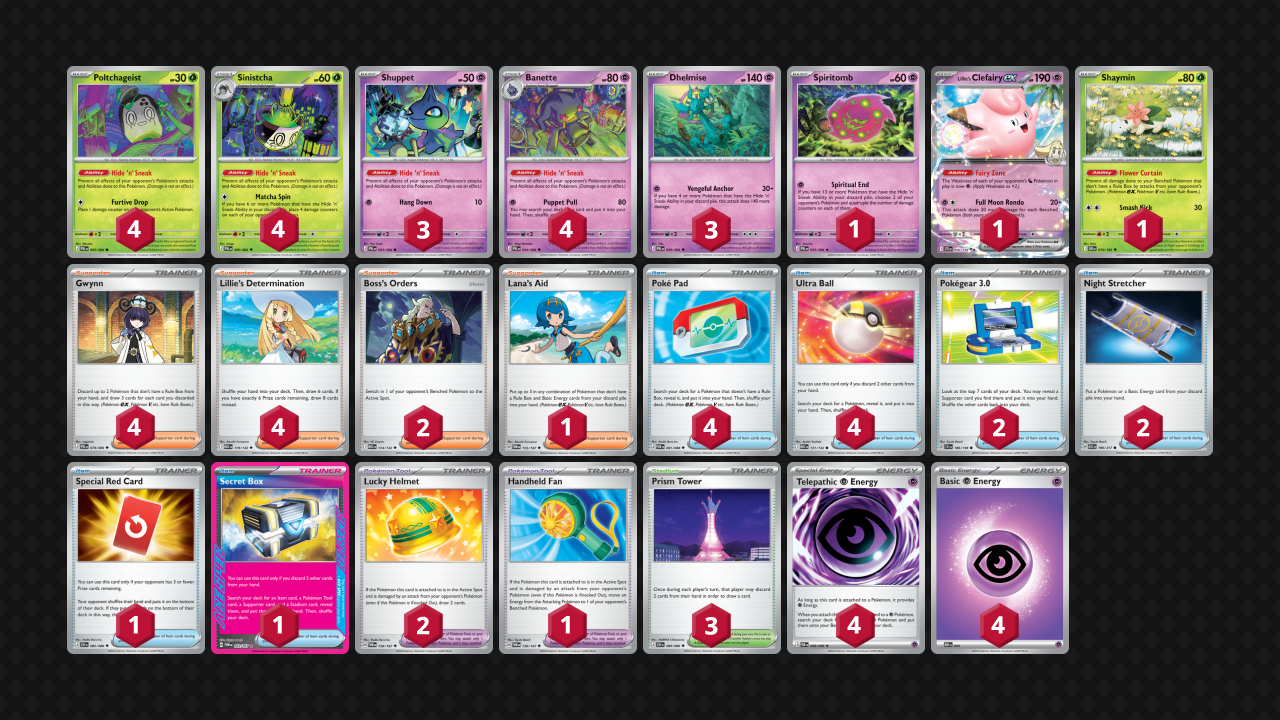
On the other hand, a “counters-based” approach tries to leverage attacks that spread Damage counters across the board and Spiritomb plays a very, very important role in closing up the games. In order for this strategy to work, you have to increase the Hide ‘nd Sneak cards with the ability you run because, well, you need to discard at least 13 of them. In order to make sure you have enough space one Dhelmise is typically sacrificed.
-
4Poltchageist PBL 5
-
1Sinistcha PBL 6
-
3Shuppet PBL 33
-
4Banette PBL 34
-
3Dhelmise PBL 39
-
1Spiritomb PBL 35
-
1Lillie's Clefairy ex JTG 56
-
1Shaymin DRI 10
-
4Gwynn PBL 78
-
4Lillie's Determination MEG 119
-
2Boss's Orders MEG 114
-
1Lana's Aid TWM 155
-
4Poké Pad POR 81
-
4Ultra Ball MEG 131
-
2Pokégear 3.0 SVI 186
-
2Night Stretcher ASC 196
-
1Special Red Card CRI 82
-
1Secret Box TWM 163
-
2Lucky Helmet TWM 158
-
1Handheld Fan TWM 150
-
3Prism Tower CRI 80
-
4Telepathic Psychic Energy POR 88
-
1Psychic Energy MEE 5
This is the list by Alex Cowen.
However, you are probably seeing that both decklists run, at the end of the day, very similar cards and that is to be expected since, at their core, they are the same archetype. So my advice in all this would be: start with the core, test, and then adjust the Hide ‘nd Sneak spectrum to how you like best.
So, let’s start together with the “must-haves” and then discuss the different routes you can go for.
Dhelmise. (3-4 copies)
No matter how you build your deck, Dhelmise will always play an important role since it is the most efficient attacker you have available. You will need a very, very strong reason to run less than 3 in any build.
Shuppet and Banette (4-3 or 4-4 line)
At the end of the day, you don’t have that many Hide ‘nd Sneakers available so if you want to make sure that you are unlocking the extra effects in the first few turns, you will need to run a considerable amount of decks. If you are
Poltchageist and Sinistcha. (2-1 to 4-4 copies)
This is the biggest difference in each of the lists: You can either run a thin “just in case” type of line or, if you want to play Spiritomb in the late game, you will need to increase the copies you run
Shaymin & Patrat (1 copy)
These two, to me, are really important cards you can’t ignore. Well, I mean, technically you can, since they are not part per se of the deck itself but they cover a lot of the weaknesses the deck has. Shaymin protects our Pokémon from being KO’ed on the bench by the likes of Meta Starmie ex or Waterspring Ogerpon. Patarat is a very interesting addition because its sole purpose is to try to stop Munkidori’s healing. Yes, as I just said, healing is a very very big problem for this deck since you literally can’t reach numbers with Dhelmise.
Lillie’s Cleffairy ex (1 copy)
I have to say that I am not a fan of this card. Yes, I get why we run it, as we need it to stand a chance against Dragapult, the most popular deck in the meta right now. But it is a two-prize card liability and can become a big problem if we open with it. In any case, don’t pay attention to my complaints, this is a card that you need to run unless your strategy is to avoid Dragrapult for your entire tournament run.
Ultra Ball. (4 copies)
This is probably the most important card of the deck. You need to discard cards and you need to find your Pokémon. There is no better option than Ultra Ball. Do not run fewer than 4 copies.
Poképad. (4 copies)
Similar to Ultra Ball, you really need to run them, otherwise you will not be able to find the cards you need
Prism Tower. (3 copies)
I honestly think there should be no debate as to what is the best stadium card for Hide ‘nd Sneak since there is only one we have available that allows us to discard cards while drawing some resources at the same time. 3 is the accepted number for most players and I honestly agree.
Gwynn. (2-4 copies)
Gwynn is THE supporter for Hide ‘nd Sneak (in fact, it was not a coincidence that was actually released as well in Pitch Black) since it allows us to discard non-rule box Pokémon and draw cards in the process. This is the supporter we always want to use in the first turns and the one that will allow our Dhelmise to attack the moment we bench it. The minimum amount of this card I have seen are 2 copies and I think the ideal number might be probably 3. On the one hand, you want to see it as soon as possible but on the other, it might become a bit of a dead card later on once you have enough cards in the discard pile.
Lillie’s Determination. (2-4 copies)
Nothing to say here except that all decks in the format run this card. It is the best set up supporter we have in the game and it will remain like that for a while.
Boss’s Orders. (2-3 copies)
Boss is a staple card in every deck, you really need to run it, nothing to discuss here.
Night Stretcher, Buddy Buddy Poffin, Air Balloon (1-2 copies of each)
The last sets of cards I feel are a must but the numbers are very different list to list. I think you should really consider including at least 2 copies of each except for, maybe, Air Ballon (and only if you run other cards to retreat your active Pokémon). At the end of the day, bear in mind these are consistency cards so, as it happens with Ultra Ball or Poképads, you will need to have a very, very strong reason not to run them.
The Ace Spec question and adding your own unique flavors
I think what we’ve covered until now is the “accepted” core of any Hide ‘nd Sneak deck. However, there is a very, very important question that we have yet to answer: What is the right Ace Spec?
I honestly have debated a lot with friends and honestly, I don’t think there is an easy answer. In my experience there are three Ace Spec cards that can easily fit into your build: Brilliant Blender, Secret Box and Legacy Energy.
- Brilliant Blender is a no-brainer, a card that allows you to discard cards in a deck that requires cards being discarded. A match made in heaven, especially if you are playing the counter-based build. However, bear in mind this card is not very flexible, in the sense that it provides speed but “nothing” more. While this is good, you are kinda giving up the possibility of finding additional resources during the games.
- Secret Box is honestly a favorite of mine. Yes, I know it might feel a bit more situational but honestly, in a deck where you need too many combo pieces, a card that fetches you 4, this is something you should definitely consider. By discarding three cards (which can be Hide ‘nd Sneakers, mind you), you get to find so many different resources for an explosive turn. Not to mention that while Brilliant Blender, for instance, does not allow you to keep progressing in the game, Secret Box does.
- Legacy Energy is also an interesting choice, especially for the Dhelmise decks. The idea is simple, you make your price trade much more efficient against other one-price decks. However, my only concern with this card is that it can sometimes be discarded (enhanced hammer) or dealt with, resulting in having wasted your Ace Spec spot.
So, in a nutshell: Brilliant Blender is perfect for speed, Secret Box is perfect for combo and Legacy Energy is perfect to get a price race advantage.
And then, you really need to consider what your deck is missing to be well-rounded. If you want a very strong, late-game attacker, you probably want to consider Ursaluna ex. If you have space, you might also want to run some generic disruption options like Special Red Card and even, if your build allows it, a Pokémon line that helps you draw cards like Dudunsparce. You could even consider something like Fezandipiti ex but it kinda defeats the purpose of running just one-prize cards in your deck.
With all that we’ve discussed until now, what version should you play, you ask? Well, that is a very tricky question that only you can answer (sigh, ok, Elena, not useful). My advice, as always, would be to test both decks and then decide which one makes you feel more comfortable but if you still need some guidance, this is what you need to know about these two variants we’ve just covered:
Dhelmise:
Dhelmisei is a very straightforward deck, for good or worse. In fact, some players will go as far as to call it “one trick phony”, in the sense that its main play style is literally using Vengeful Anchor turn after turn. And yes, dealing 170 damage is as strong as it sounds on paper but if dealing damage was just what made a deck good, Raging Bolt would be the best strategy in the format (and it is far from it). So yes, the deck is somewhat limited, but on the bright side, it is more consistent and more aggressive. In fact, it is not rare to see a thin Dudunsparce line being added to the deck to ensure some additional draw in mid and late game.
The good
More consistent and aggressive
Has space to run tech cards or a draw engine (Dududnsparce)
Low cognitive effort, ideal for long tournaments
The bad
Very sensitive to healing cards like Munkidori
Not great against decks with very high HPs (Garchomp ex)
Spiritomb variants:
Hide ‘nd Sneak with Spiritomb is definitely a much more complex deck to build and to pilot. You will probably need to know exactly which is the right Pokémon to attack on a turn basis because, while Dhelmise of course plays an important role, it is not the only one you need to use. In fact, the deck tries to use Sinistcha a lot in order to ensure you are placing enough damage counters in big Pokémon and then finish them off with a late game Spiritomb. The downside, however, is clear. Because Spiritomb requires at least 13 Hide ‘nd Sneak(ers) in your discard pile, you need to add between 4 to 6 extra cards with this ability to your deck. As such, you simply don’t have all the space you want, becoming much more dependent on your supporter cards to draw the resources you need.
The good
Many more options during the game
Can take multiple KOs in one turn without relying on Boss’s Orders
Better for the late game
The bad
Less space to run a draw engine
Can’t afford to run Legacy Energy, key against other one-prize decks
It is still a bit early to give you a final conclusion about these decks because the first and real big test will be the Worlds Championship (August 2026) but I have the feeling that Spread is better than straight Dhelmise, or at least a variant that meets in the middle. However, if you are a new player and want to get to become familiar with the archetype, I would 100% recommend you testing Dhelmise first. After a while, if you like the dynamic, start experimenting a bit more with the rest of the cards we’ve listed in the article and adjust the numbers.
Matchups
I don’t want to focus too much on concrete deck examples because, if I did, this guide will quickly become obsolete, so allow me to cover which type of decks we have an advantage/disadvantage against and why. If you understand the reason behind certain dynamics, you should be able to apply them to any deck in the format.
Advantages:
The decks we should always beat are those that focus way too much on multiple-price Pokémon, especially Mega Evolution ones. They simply can't trade prizes well against Dhelmise, especially if you start attacking first. Needless to say, if you go against something that happens to be weak to Psychich, like Mega Lucario ex, they don’t even stand a chance.
Against one-price decks, you should always have the advantage as long as you attack first, and you usually do. The only exception to this rule is Festival Lead, which can take 2 prizes every turn thanks to Galdio’s help, so if you suspect Festival Lead is going to be a popular choice in your next tournament, consider teching against it with Flutter Mane or Handheld Fan.
Disadvantages:
As we’ve mentioned several times, a deck that runs multiple healing options (whether that is something like Jumbo Ice Cream or Munkidori) messes up your maths, forcing Dhelmise to attack 3 times to get a KO on a two–price Pokémon, which is not ideal at all. That is precisely why Dragapult variants like Blaziken and Straight Dragapult do normally have a very strong matchup against you, since they can very consistently power up two Munkidori every game. Speaking about the Dragapult matchup, yes, it is winable but it is not as one-sided as people started theorizing when they read the scans: Dragapult is much more consistent than you are, it can disrupt your hand very easily and has access to healing, so even if you have the type advantage to your side, you will really need to fight hard and make sure you are playing carefully around Phantom Dive.
Additionally, anything that damages your bench is kind of a problem, since you almost solely rely on Shaymin to protect your setup and about turns where your opponent takes multiple prizes. I think, by far, one of your worst matchups is Marnie’s Grimmsnarl, which has the type advantage, deals bench damage, and runs 4 copies of Munkidori. Truly a nightmare.

Source: Pokehive on X
While we really need to pick the above data with a grain of salt, this is what recent online tournaments are reflecting so far, Yes, online tournaments do not reflect well the reality of a deck but I think it can kinda give you an idea of the strengths and weaknesses of the current Hide 'nd Sneak builds.
Worlds 2026 and the future of Hide and Sneak
As I said, it is still very early to write a proper conclusion on the deck. What we can say for certain (for now) are two things: the deck is very, very popular and it has barely been able to shake up the metagame in Japan over the past 3 months. It does not mean the deck is bad per se, new decks always struggle to have an impact during their first weeks. And it can be the case that players just need to come with the right variant… I have the feeling that current builds are somewhat limited so I am kinda of expecting a crazy build that will turn everything upside down.
Also, let’s not forget that archetypes are not usually a “released and done” thing, they normally get a lot more support over the next sets. Take N’s Zoroark, for example. The card always had potential but it was not perhaps the best deck ever. However, a couple of sets after Zoroark made its appearance, Pokémon decided to release N’s Zekrom, which was literally the missing element, the one puzzle piece that made Zoroark go from decent to extraordinary. So, what I am trying to say is that even if Hide ‘nd Sneak is not Dragapult-level good right now, it might be in the future. Call it a hunch.
I actually expect very experienced players going with Hide ‘and Sneak into San Francisco’s Worlds and I am really excited to see how they approach the build. My gut feeling, again, is that the deck that will get the best placement will be a Spiritomb build, I am already calling it.
In conclusion
Hide ‘nd Sneak is a very promising deck with a dynamic that feels like fresh air in a format where new strategies are very, very rare. The deck follows the path of other strong and popular decks in past formats like Night March, Mad Party and even the popular Lost March.
While the community agrees on the core, the reality is that there is still a lot of discussion going on and I feel we, as a community, have not yet fully cracked the Hide ‘nd Sneak code. If you want to give it a try, I really recommend you to the cards. Even if the deck still can’t compete at the highest of the levels, I think it will be eventually an archetype that will claim its spot in the meta.
Thanks for reading and hope this small (well, maybe not small, but certainly humble) guide was of help. Happy testing!