

Pauper Mono Blue Faeries: Revolutionised with a Single Card



Mono Blue Faeries is arguably the oldest and most iconic Pauper deck of all time. It has changed over time and even nowadays it gets a small bump here and there. Today, I will talk about one of those bumps, and one that has been pretty consequential - Sewer-veillance Cam.
First, I'll explain who I am in the context of Fae. Then, I'll move on to what the deck's plan normally is, how Cam fits this plan, and how it has changed the outlook on the deck. Naturally, you'll also find a decklist here and a bunch of other written and video resources attached.
Without further ado, let's jump in!
Who am I to talk about Fae?

I won Paupergeddon Trios, I top4ed and top16ed Paupergeddon, became Top8 LPI player of the year, Top16ed Top Pauper Player, and won Polish Nationals - all with Mono Blue Fae.
Moreover, within the Polish Pauper tournament series C'mon, I made the finals of a singles event, won trios the day after, and at the next event of the series, I top8ed solos and defended our trios championship; still all with Mono Blue Fae.
With my resume, I'd also started a YouTube channel, I stream on Twitch, and I also give coaching and provide in-depth, expert-level content on my Metafy.
Last but definitely not least, I have a free public Fae Discord community with almost 2000 members, all centred around Fae! Definitely a place to check out if you want to ask some questions!
With all of that background info out of the way, let's get into the deck itself and Camera!
What is Mono Blue Fae?
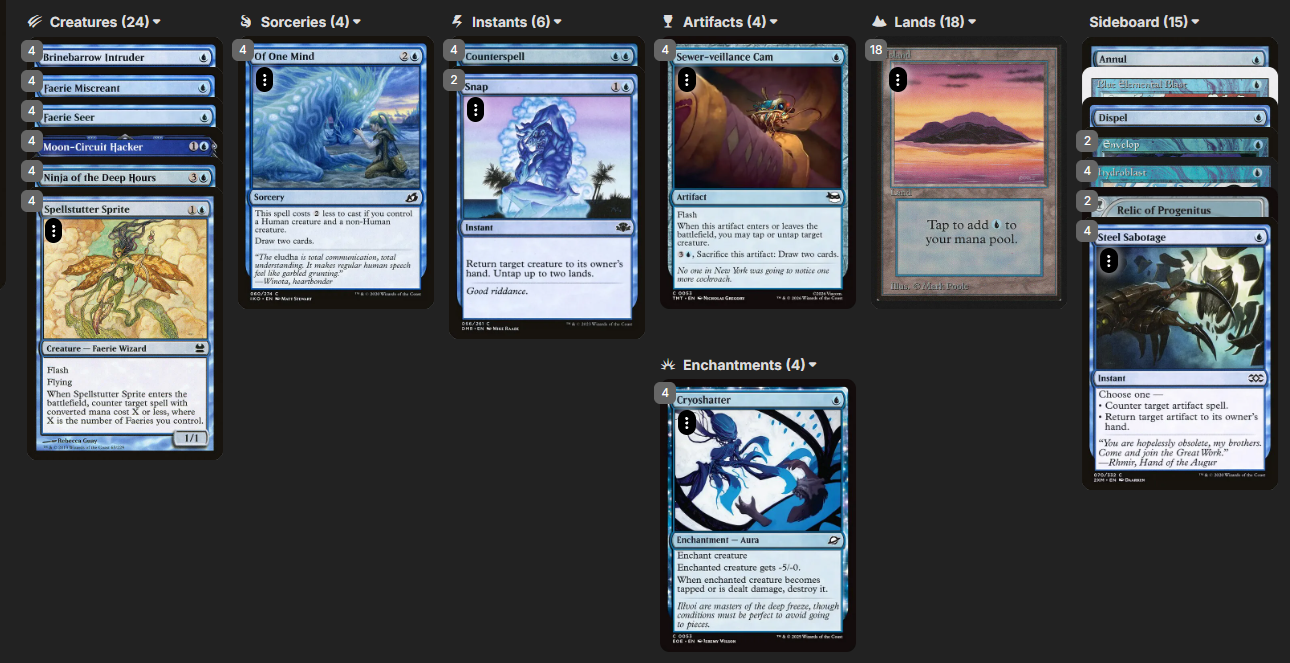


-
4Brinebarrow Intruder

-
4Faerie Miscreant
-
4Faerie Seer
-
2Spellstutter Sprite

-
4Moon-Circuit Hacker
-
4Ninja of the Deep Hours

-
4Counterspell
-
4Cryoshatter
-
4Of One Mind

-
4Sewer-veillance Cam
-
2Snap
-
18Island
-
1Annul
-
4Steel Sabotage
-
1Blue Elemental Blast
-
4Hydroblast
-
2Envelop
-
1Dispel
-
2Relic of Progenitus
Mono Blue Fae is a tempo deck that plays a very interactive game. It is proactive at heart and has its own plan that it wants to enact. That plan is typically a one-drop creature on turn one, followed by a Ninja that snowballs your advantage. Then, you want to use your interaction to stop the opponent's plan or protect your own plan, while drawing more cards and swarming the opponent in the air.
There are a lot of misconceptions about the deck and to name just a few:
- This is not a damage-output aggro deck. It doesn't care that much about pushing raw damage through. It's more about accruing resources and interacting with the opponent.
- Even though the deck is blue, it's not meant to be reactive. It is proactive and interactive, but it is all with the idea that you have to enact your own plan - not just try to endlessly answer the opponent's stuff.
- This deck is easy to pick up, but it's super hard to master. You can get through a couple of your first games by trying to counter stuff and put Ninjas in. However, there is a near-endless learning curve, which is necessary, because the raw power level of the deck is relatively low - it relies much more on synergies and the fact that the sum of the parts is greater than the individual parts.
How does Sewer-veillance Cam fit the deck?
Let's now analyse how the Cam can fit into our plan that I outlined above.
First, I shall explore the immediate doubts about the card:
- The tap happens just once, so it looks worse than an Unsummon
- The untap doesn't look terrific in a deck that not only doesn't want to block but also just doesn't have bigger creatures to block with
- The sacrifice ability costs 4 mana, which is a lot in a deck that otherwise focuses on a super low curve.
Are the above doubts true or just the upsides outshine them? Yes to both but not really. Let's add some nuance.
I will say right off the bat that the first two points are absolutely true. Tap happens once, the opponent keeps the creature for next turn, and we will infrequently untap our creatures to block. However, there are so many upsides that I can lose count. Let's split it into categories
The Draw 2
- While the sacrifice ability costs 4 and it is a lot, getting a mid-late game draw 2 effect that's uncounterable is super valuable. With numerous Cams in the deck, it's very easy to keep chaining them and never let the opponent out of the constant tappage chokehold, all while drawing more cards.
- Sometimes you'd have mana unspent when the opponent passes back, so you can cash in the Cam to draw.
- It alleviates issues with flooding, as you have those draw2s in the deck.
- It alleviates the issue of bad top decks, as you have those draw2s in the deck.
- Because of the super low curve of the deck, it's very easy to unload all the cards drawn off Cam.
The instant-speed tap
- With so many flyers in our deck, only opposing creatures with flying or reach typically matter, so you can focus on countering those. And if one slips through, that's the main target of tapping.
- Instant speed allows you to tap an opposing creature on upkeep, which will disallow the opponent from using its abilities, like Priest of Titania.
- Instant speed allows you to stop an opponent's big creature from attacking you, making the race beneficial in your favour.
- Instant speed allows you to see how the opponent plays out their turn and only at the end decide what to tap.
The untap
- Untap comes into play when you untap your 1/2 or 2/2 to block their small creature.
- Untap comes into play when you untap your creature to have a surprise blocker and stay alive.
- Untap comes into play to counteract some opposing effects like Sleep of the Dead or Bind the Monster.
Other aspects
- It synergises with Cryoshatter in the sense that you can immediately kill an opposing creature.
- It allows us to have a light 'removal' spell in the main deck, which in non-creature matchups still has the utility of being a Divination
- The presence of Cam makes the opponent hesitant in making proper attacks; if they split-attack and keep one blocker back, it's always vulnerable to getting tapped.
As you can see, the list of upsides is pretty massive. The combination of all of those makes it not only a way to bring the power level of the deck up, but also a true pain to play against from the opponent's perspective.
Is the Cam here to stay?
As of now, I'd say the answer is a resounding YES.
While nothing is stopping you from playing some other versions of the deck, I'd risk a statement that whatever list you're playing would benefit from just adding 3-4 Cams into it.
When a new effect for Fae is printed, we will re-assess. I do not believe there are 'sacred cows' that should never be cut. However, there is no reason right now to build your deck in a nonCam manner.
More Resources on Mono Blue Fae
Let me now show you a couple of resources that might be of use for you, regardless of whether you're new to Pauper, new to Faeries, or want to go from beginner to pro.
- New player Guide to Fae
- Mono Blue Fae Cam video deck tech
- Free compendium of resources to Fae
- [paid] My super in-depth Guide to Fae to truly step up your game
Thanks and I hope to see you in the Fae discord soon <3